Start with the voltage of the cart, then choose capacity for how far you drive between charges. A lithium golf cart battery has to suit the cart's controller and charger too, not just fit the tray. New to 36V and 48V systems? Our guide to lithium battery voltage explains how the numbers work.
What to Look for in Golf Cart Batteries
LiFePO4 chemistry for deep cycle use
Not all lithium batteries use the same chemistry. Every battery in this range is lithium iron phosphate (LiFePO4), the chemistry most often chosen for deep cycle jobs like golf carts. It is thermally stable, copes with vibration and repeated deep cycling, and is far less prone to thermal runaway than the nickel and cobalt based lithium cells used in many phones and power tools.
Voltage that matches the cart
Most electric golf carts run a 36V or 48V system. Check the cart's plate, manual or existing battery bank before you buy, then match it. A 48V lithium golf cart battery usually reads 51.2V nominal, which is normal for a LiFePO4 pack built for a 48V system. It is not a sign the battery is wrong for the cart.
Capacity and range
Capacity is listed in amp-hours (Ah) or kilowatt-hours (kWh). More capacity means more driving between charges, but range also depends on hills, load, tyre pressure, speed and how many passengers are on board. As a guide, the Amptron 48V 105Ah golf cart battery stores about 5.4kWh, while the Amptron BluEdge 48V 78Ah stores about 3.99kWh. Pick capacity for your longest regular day, with some reserve.
Discharge current for hills and take-off
The battery's continuous discharge rating needs to cover what the motor and controller draw, especially on climbs and from a standing start. Ratings vary widely across the range, from 60A on a small 30Ah pack to 180A continuous on the Amptron 48V 105Ah. Match the battery to the controller rather than buying on capacity alone.
Weight and fit in the battery tray
Lithium golf cart batteries are much lighter than a bank of lead-acid batteries doing the same job. In this range, weights run from about 12.5kg for a small Invicta 48V 30Ah to about 51kg for the Amptron 48V 105Ah. Measure the tray and check the battery's dimensions before you order, and secure it with proper brackets or hold-downs so it cannot shift on rough tracks. A lighter battery also means a lighter cart, so the motor has less weight to move on every hill.
Converting a Golf Cart from Lead-Acid to Lithium
One pack instead of several batteries
Many carts run a series bank of several lead-acid batteries to reach 36V or 48V. A lithium golf cart battery replaces that bank with a single pack at the system voltage. That frees up space, cuts weight and removes the need to check water levels or clean corroded terminals. If a cart is set up with several 12V lithium batteries in series instead of one pack, the batteries need to stay balanced, which is one reason a single pack at the system voltage is simpler.
Charger and controller compatibility
A lead-acid golf cart charger is not the right charger for lithium. Use a charger with a LiFePO4 profile at the correct voltage. Some carts use a charger that talks to the cart's onboard computer, so check how your cart charges before you swap. Lithium also accepts a higher charge current than lead-acid, so a matched charger can turn a cart around much faster between rounds. See our lithium battery chargers for matched options.
State of charge gauge
The original fuel gauge in many carts is set up for lead-acid voltages and may read wrongly with lithium. Some packs in this range include Bluetooth monitoring or an LCD gauge, so you can see state of charge, voltage and temperature without relying on the old gauge.
Lithium Golf Cart Batteries by Voltage
36V golf cart batteries
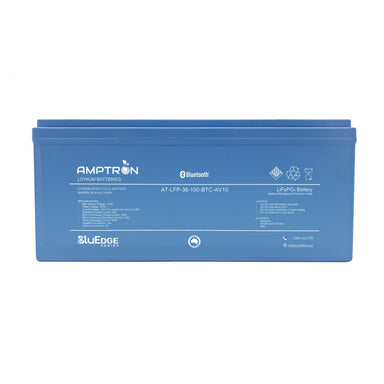
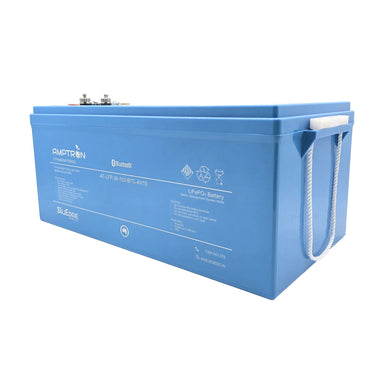
Use a 36V lithium battery when the cart is a 36V system. Options include the Amptron 36V 85Ah, the Amptron BluEdge 36V 100Ah and the Enerdrive B-TEC 36V 100Ah. Browse all 36V lithium batteries.
48V golf cart batteries
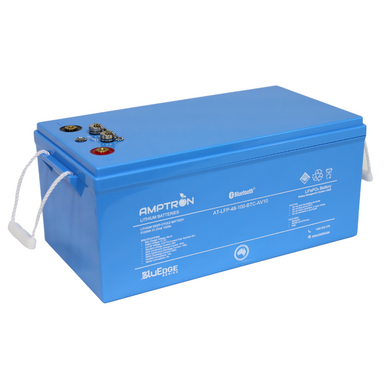
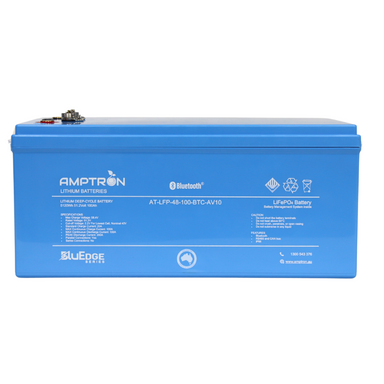
48V is the most common choice for newer carts, buggies and utility vehicles. Options include Amptron golf cart packs at 78Ah and 105Ah, the Amptron BluEdge 48V 100Ah and Invicta 48V packs. Browse all 48V lithium batteries.
Looking After a Lithium Golf Cart Battery
LiFePO4 batteries do not need watering or equalising charges. The built-in battery management system (BMS) monitors voltage, current and temperature, and protects against over-charge, over-discharge, short circuit and temperature extremes. That said, low maintenance is not no maintenance.
- Check the terminals now and then and tighten anything loose. Vibration on the course and on rough tracks can work connections free.
- Look over the case and cables for damage, and treat a noticeable drop in run time as a reason to have the setup checked.
- Do not leave the battery sitting on a charger indefinitely. Once it is full, switch the charger off or disconnect it unless the charger is designed for lithium storage.
- Avoid charging below 0°C, and if the cart will sit for the off-season, store the battery part charged and use the isolation switch if it has one.
Why Buy Golf Cart Batteries from Outback SafeTrack
- Free Shipping: Orders over $299* ship free across Australia.
- Price Match Guarantee: Found golf cart batteries cheaper? Call us.
- Fast Delivery: Most orders arrive in 2-10 business days, or we'll send a $100 gift voucher.
- 30-Day Returns: No restocking fees on eligible returns.
- Expert Support: Voltage, controller or charger questions. Call 1300 902 361.
- Aussie-based service: Lithium packs picked for carts, buggies and utility vehicles.
Find the Right Lithium Battery for Your Golf Cart
Shop golf cart batteries, match the voltage to the cart, then pick capacity for your longest day out. Unsure which pack suits your cart? We'll help you pick.
Read less