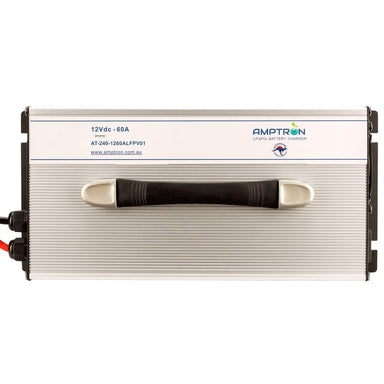
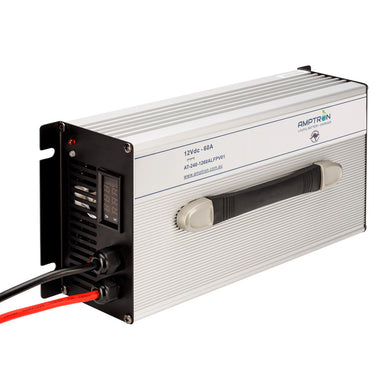
A lead-acid charger is not a lithium charger. Match the voltage, then pick how you charge: AC from the wall, DC-DC from the alternator, or solar through a regulator with a lithium profile. New to panels? Start with our guide on how to charge a battery from solar panels.
What to Look for in a Lithium Battery Charger
A lithium charge profile
A lithium battery charger should bulk around 14.4-14.6V on a 12V pack, then float lower, and stop rather than trickle-cook the cells. If the charger only has AGM or gel, it is the wrong tool. The same idea scales for 24V, 36V and 48V. The voltages are higher, the profile is still lithium.
Amps that match the battery, not just the hurry
Faster is not always better. A small battery wants a modest charge current. A large bank can take more. Check the battery's recommended charge rate, then pick a lithium battery charger that sits inside it. Multi-stage charging does the thinking so you are not watching a voltmeter.
The source you actually use
Mains is simple at home or in a park. DC-DC is how you charge while driving without asking the alternator to guess. Solar needs a regulator with a lithium setting, not a charger bolted on and hoped for the best. See lithium camping batteries if you are still matching the battery itself.
Lithium Battery Chargers by Charge Source
AC lithium battery chargers
Use an AC lithium battery charger when you can plug into mains. Match 12V, 24V, 36V or 48V to the battery, then choose the amp rate the battery can accept. Good for a top-up at home, in a caravan park, or after a trip.
DC-DC lithium battery chargers
A DC-DC lithium battery charger sits between the vehicle alternator and the auxiliary battery. It lifts and regulates the voltage so the lithium pack charges properly and the vehicle electrical system is protected. Use one whenever you want to charge on the move.
Solar charging for lithium batteries
Panels can stay. The regulator needs a lithium or LiFePO4 profile, with bulk and float set for the battery voltage. MPPT usually makes more of a cloudy day than PWM. A charger and a solar controller are different jobs. Do not skip the profile because the panels are already on the roof.
Why Buy Lithium Battery Chargers from Outback SafeTrack
- Free Shipping: Orders over $299* ship free across Australia.
- Price Match Guarantee: Found lithium battery chargers cheaper? Call us.
- Fast Delivery: Most orders arrive in 2-10 business days, or we'll send a $100 gift voucher.
- 30-Day Returns: No restocking fees on eligible returns.
- Expert Support: Mains, DC-DC or solar, and the right voltage. Call 1300 902 361.
- Aussie-based service: Gear picked for camping, touring and backup, not a lead-acid leftover.
Find the Right Lithium Battery Charger
Shop lithium battery chargers, match the voltage, then pick mains, DC-DC or solar. Unsure what the battery can accept? We'll help you pick.
Read less